
Tips for Localities: Coordinate with EMS Before and During Disaster
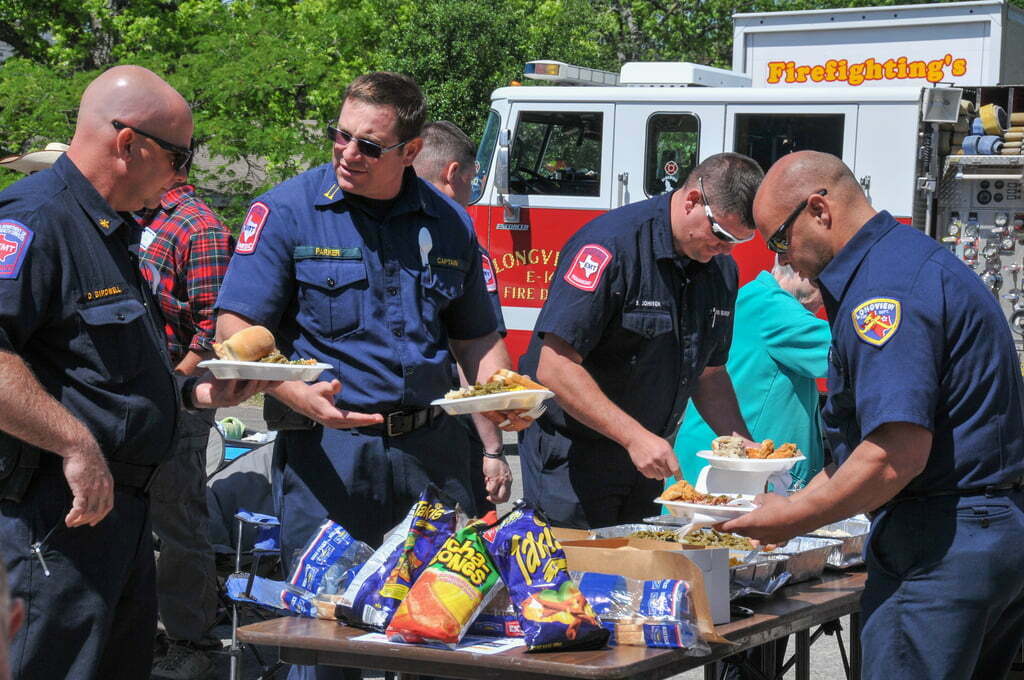
First responders line up for a special meal at the First Baptist Church in West, Texas. Photo provided courtesy of FEMA.
Although EMS professional’s day-to-day activities will cross-over into disaster response, they will likely experience heightened emotional and physical stress that comes with disaster response. City managers, emergency managers, local charitable organizations and nonprofits, and other relevant community stakeholders should work with EMS managers and supervisors during disaster planning and response to provide stress relief for first responders and ensure operations run smoothly.
Below, Ken Parker, retired city manager of Port Orange, Florida, provides best practices and advice for localities based on his experience working with his local EMS professionals before and during disasters.
Have stress relief and incident debriefing teams available.
- Be aware that EMS professionals can become more emotionally involved in their work as they are often responding to family, friends and neighbors impacted by disaster. Likewise, EMS professional’s can be dealing with personal impacts of the disaster on their own families. Take extra measures to check in with EMS professionals to keep exhaustion and emotional stress under control.
- Provide incident debriefing teams to help EMS professionals handle stress and discuss what they just went through or are still going through.
- Consider bringing in a massage therapist, therapy animals and other forms of stress relief that can lift spirits and relieve stress. The city or local charitable and nonprofit organizations may be able to assist with this effort.
Accommodate EMS professionals’ basic needs.
- Make sure EMS professionals are fed, hydrated and have a place to shower. Work with the city or with local charitable and nonprofit organizations to provide provide meals and other personal care items. During disaster planning, identify who will be responsible for providing this, in addition to multiple locations where EMS professionals can gather for meals.
- Ensure EMS and first responders have time to be with their families at the end of their shifts. “We provided our EMS workers and their families with meals each night throughout disaster response,” Parker says.
Work with your parks & recreation department to provide childcare for first responders and their families.
- Oftentimes both parents are in EMS or needed at work, leaving them to make last-minute, stressful childcare arrangements. Write childcare plans into your locality’s emergency operations plan (EOP) and ensure arrangements can be put in place as soon as disaster response begins.
Make sure an EMS professional is on staff at the dispatch center.
“The dispatch center almost always gets overwhelmed, and someone is going to have to triage the calls,” Parker says. “This needs to be an EMS professional because they are the ones that can evaluate the calls and prioritize which requests are most urgent to respond to. We always have our EMS manager in that position.”
Facilitate communications between EMS and across all departments, and ensure the communications loop is closed.
- All information needs to be communicated from EMS up the chain of command to the emergency operations center (EOC) and back down again to the EMS team. If EMS has exhausted their resources, for example, they must notify the EOC so incident command can set mutual aid agreements into place, or assist in developing a plan if mutual aid is unavailable.
- Ensure EMS situational reports and updates are sent to all local departments, and vice versa. Public works, for example, must communicate road closures and available routes in order for EMS to respond.
Encourage EMS workers to take a wide range of training.
- In addition to normal training, EMS and fire service professionals should be trained in search and rescue, trench training and other training relevant to community-specific threats.
- EMS should exercise mass casualty drills with emergency management. Hold mass casualty tabletop exercises with all stakeholders and simulate real disasters at least once per year to build repetition so that response becomes second-nature for EMS professionals and all stakeholders.
- See more about FEMA’s national emergency responder credentialing requirements and the training required for each specialized EMS position.