
Communications Tips for Local Elected Officials
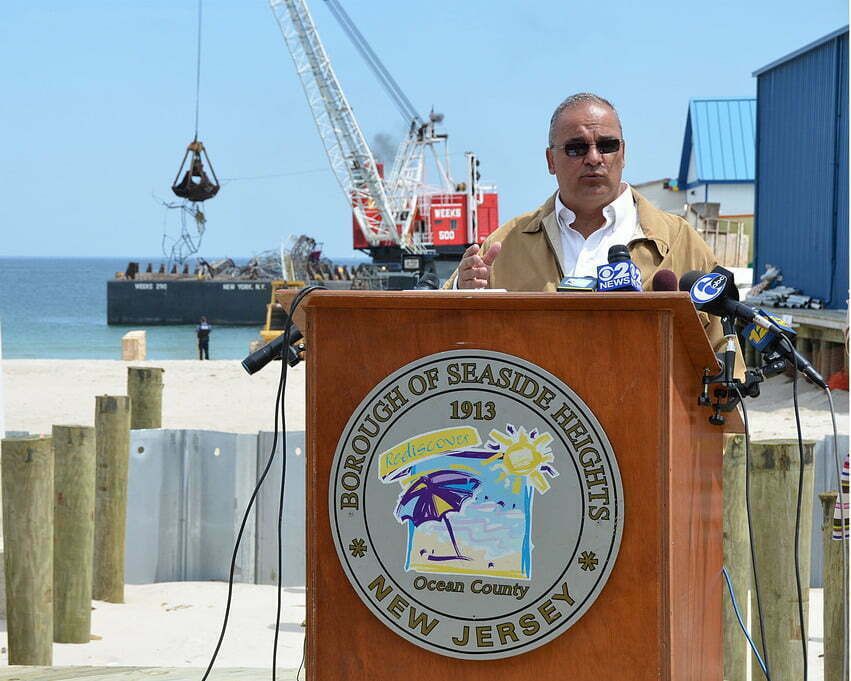
Mayor of Seaside Heights, N.J., William Aker gives an update on recovery progress after Hurricane Sandy. Photo courtesy of FEMA.
Residents look to their elected officials for signs of hope and recovery after a natural disaster; it’s important for local elected officials to be informed enough to provide accurate — and empathetic — answers on the response and recovery process to the community. These tips provide advice for local elected officials to effectively engage in disaster response and recovery communications efforts in a way that supports incident command’s operations.
Be prepared for calls and questions to come in after recovery ends.
- Residents feel like they’ve waited long enough and they often start calling their local elected officials with questions and concerns on recovery efforts. Local elected officials must be briefed regularly and trained on the recovery process and plan so they can provide detailed answers.
- For example, be prepared to explain the debris removal process and provide a pickup estimation time to a resident.
Maintain a consistent presence in the community.
- Get out in the community and assist with activities such as food and water distribution, or partner with a police officer to notify residents of mandatory evacuations before a disaster. Residents often respond differently to local elected officials than to other stakeholders, like law enforcement and emergency management.
- Take advantage of opportunities to see damage and response and recovery efforts first-hand. Be sure to share any feedback or comments with emergency management and other stakeholders. Local elected officials hold valuable, but often overlooked, insight into disaster response and recovery.
Don’t be afraid to pass off questions from the media to SMEs.
- The press often wants to hear from local elected officials. Make sure you are briefed on the status of response or recovery before any interview. Don’t be afraid to say, ‘‘Let me have the EMS supervisor or police chief address that issue,” on areas where other stakeholders have more expertise.
Be prepared to explain the funding process for different sources, like FEMA, HUD and SBA.
- Explain the process to residents as soon as possible to prevent duplication of benefits (DOB) and frustration when funding is denied.
- Know exactly who you’re dealing with for each bucket of funding — you may be dealing with the federal level directly, or working through the state to reach the federal level.
- Don’t waste time applying for reimbursement to the wrong agency. For example, there are awards from the Federal Highway System to assist with damage to federal highways; if you apply to FEMA for reimbursement on federal highways, your request will be denied.
- Make sure you can explain how Small Business Association (SBA) loans work, because oftentimes residents will get SBA loans and then have the loan counted against their FEMA or Community Development Block Grant Disaster Recovery (CDBG-DR) award.
Relevant legislation, policy or regulation:
Emergency Relief Program, U.S.C. Title 23, Ch. 1, Sec. 125, Jan. 23, 2011