
Experience Gained: Volunteer Coordination – a Centralized Approach to Managing Volunteers
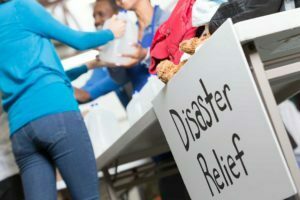
Taking a centralized approach to managing volunteers can help localities maximize the potential of volunteers and leverage the efforts of enthusiastic community members.
IBTS subject matter experts and community emergency management professionals share their experiences and lessons learned in how to centralize volunteers.
The Volunteer Reception Center (VRC) is a designated location used to connect affiliated and already credentialed volunteers with new, non-affiliated volunteers. “The VRC is used as a place to credential and train volunteers and serves as a seamless community relief and recovery area,” says Claire Collins, IBTS development manager for local government solutions. The VRC also functions as the disaster and family assistance center for relief and recovery, often making it the community focal point for distribution of food, clothing and supplies by credentialed volunteers assigned to work there.
During the Pulaski tornados in 2011, county officials set up a VRC in the gymnasium at Emory & Henry University, while the Red Cross established shelter operations at a nearby location to separate shelter operations from volunteer coordination operations. According to Denny Huff, executive director for the Bedford Community Health Foundation in Roanoke, VA, the VRC played a vital role. “With volunteers being a liability issue, the VRC helps connect non-affiliated volunteers to affiliated volunteers, allowing them to be covered by the affiliated organization’s insurance,” says Denny Huff, executive director for the Bedford Community Health Foundation in Roanoke, VA.
Localities can take several steps during the disaster planning process to ensure a smooth and quick setup of the VRC once a disaster strikes. These include:
- Identifying potential locations for the VRC. It is important to plan for multiple scenarios in case one or more identified locations has been compromised by the disaster. According to Huff, who recommends setting the VRC up periodically at community events.
A Community Emergency Response Team (CERT) trailer can also be used as the VRC. The City of Roanoke set up a CERT trailer in 2012 funded through a grant after the city was hit by derecho. CERT trailers can also used for community events and for training and keeping volunteers engaged.
- Training Staff and Volunteers. Both paid staff and volunteers should be trained in how to setup a VRC.
- Developing forms and other documents for the VRC. These include volunteer instructions, a disaster registration form with release of liability, safety checklists, and sign-in/sign-out sheets for volunteers.
- Identifying Staff and Stakeholder Roles. Localities can identify staff and outlines their roles. In particular, the VRC director and managers should be assigned their roles prior to a disaster. “Communities need for a person to lead, command, control and direct volunteers to feel wanted and engaged with a choice of listening or doing,” says Marci Stone, emergency management coordinator for the city of Roanoke, VA. Now is also the time to draft memorandums of understanding (MOUs) between volunteers and other external stakeholders.
- Designing Volunteer Job Descriptions. Although volunteer assignments will vary depending on the disaster, job descriptions can and should be written ahead of time. While affiliated volunteers have experience performing various tasks in disaster response and recovery, spontaneous volunteers should be given explicit directions on what their jobs entail.
“Job descriptions alleviate self-deployment and provide volunteers with a sense of purpose in performing duties and responsibilities,” says Collins. Stone agrees, noting that “volunteers need to know what they are and are not going to do. Make sure they understand the obligations at the beginning. Set expectations clearly.”
The Corporation for National and Community Service’s “Managing Spontaneous Volunteers in Times of Disaster,” includes several possible job descriptions appropriate for spontaneous volunteers, such as answering phones at hotline call centers and the emergency operations center (EOC), cooking or serving meals, caring for animals and sorting donations at local drop-off sites.
- Adapting volunteer coordination plans by disaster type and size. In some scenarios, a small number of volunteers with specific resources or skills can be more effective than a larger number. “Not every disaster is big,” says Stone, who explains that, after the derecho, the City of Roanoke needed volunteers with chainsaws who could help with tree removal. Likewise, during a major snowfall, communities may need volunteers with four-wheel drive vehicles to help with special transportation needs, such as driving patients to dialysis.
- Considering special needs. Volunteers are also often able to help citizens with special needs. Huff recommends creating a special needs registry that can be referred to in times of disaster.
Volunteer Capacity
Just as it’s important for volunteers to have clear expectations of their responsibilities, it’s equally important for organizers to have a clear understanding of the capacity of the volunteers they’re dealing with – how long will they be available to volunteer? Are they located nearby? What do they want to volunteer for?
Knowing these at the onset can have a huge benefit. According to Neal Turner, emergency services coordinator for Montgomery County, VA, “at the time a volunteer arrives to help, make an inquiry to know their capacity and the number of days they can provide service in advance of being credentialed.”
Knowing how long a volunteer is able to stay can also help identify which tasks he or she is assigned. Short-term volunteers should be assigned to tasks that do not require them to learn new skills or knowledge, whereas longer-term volunteers can benefit from training. Huff adds that locals often make better long-term volunteers. “Use out of town volunteers first,” he suggests, noting that these may depart after a day or two, while local volunteers may be able to continue helping over the weeks and months ahead.
Pulaski, a town of 10,000 located in Pulaski County Virginia, was hit with two tornadoes on April 8, 2011. The larger of the two left a path almost two miles long and 440-yards wide with winds estimated at 125 mph. Combined, the tornadoes damaged more than 400 homes in Pulaski and nearby Draper, and caused an estimated $8 million in damage to residents, devastating the small town.
“It’s very unusual and unexpected to have a tornado in the mountains,” says Neal Turner, Montgomery County emergency services coordinator. “Emergency and disaster response personnel in the area knew very little about tornadoes.”
Bob McDonnell, governor of Virginia at the time, declared a state of emergency on April 9, but FEMA denied the county’s request for assistance. The majority of first-responders were affiliated volunteers from local disaster response organizations, including the Red Cross – who set up an emergency shelter at Pulaski Elementary – and relief workers from Virginia Voluntary Organizations Active in Disaster (VOAD) and local churches.
Unaffiliated, or self-dispatching volunteers, were also onsite ready and willing to help after the disaster.
“Volunteers can be a saving grace in disaster recovery,” Turner says. However, it is important to understand what they can offer beyond good intentions. Self-dispatching volunteers “who come with limited skills and training and no knowledge of risks or hazards can clog up recovery,” says Turner.