
Tips for Sending Mass Messages
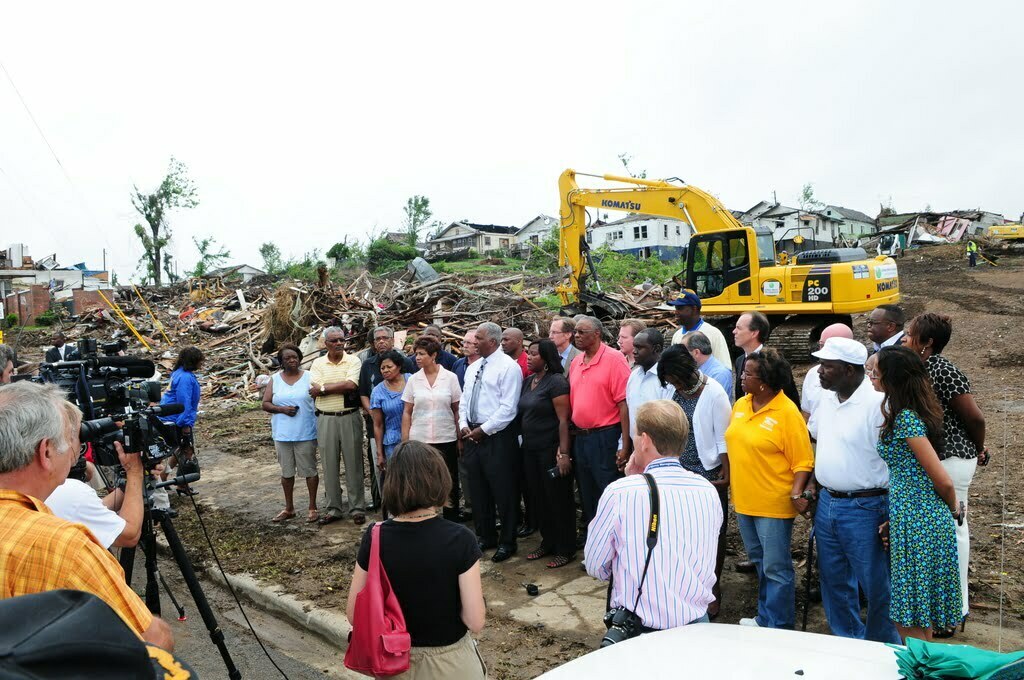
Birmingham Mayor William Bell answers questions about debris removal, registration and long-term recovery for areas affected by severe storms, tornadoes and flooding in 2011. Officials from the Alabama Emergency Management Agency, Small Business Administration, and FEMA were also present to give information on their roles in the recovery. Photo provided courtesy of FEMA.
During disaster response and recovery, mass messaging allows the community to hear the same message at the same time. This not only helps reducing the burden on public information officers, it also prevents confusion and misinformation. Use these tips to help manage make your mass messages more effective.
Have clear roles and responsibilities for creating and sending mass messages
- As with any action during disaster response, it is important to make sure that everyone understands their role in communications efforts. The public information officer (PIO) is generally in charge of managing mass communications.
- It is a good idea for more than one person to be trained on how to use mass messaging systems. For example, small localities may only have one person who knows how to access their Facebook page; this can be a problem if that person is unreachable during a disaster. However, during a disaster, only one person at a time should be responsible for sending communications. Identify roles and responsibilities clearly during disaster planning.
Develop compelling messages
- The public may ignore emergency messages or not take them seriously. This can especially be a problem if previous emergency messages were unnecessary (such as warnings for a severe storm that did not fully materialize) or if locals are used to some degree of severe weather and feel that the emergency message is not communicating anything out of the ordinary. Even after a disaster, locals may be overwhelmed and unable to keep up with messaging.
- Understand how to write compelling messages that convey an accurate degree of severity and that include useful, actionable information. Do not over-inundate the public with too many messages or unnecessary information. If possible, develop a library during disaster planning to make writing easier.
Use and encourage citizens to opt-in to alert and warning systems
- Public officials in Federal, state, territorial, tribal, and local alerting authorities can use the Integrated Public Alert and Warning System (IPAWS) for alerting the public about serious emergencies.
- Other alert and warning systems include the NOAA Weather Radio All Hazards (NWR), a nationwide network of radio stations that broadcasts warnings and emergency alerts; and local systems, such as enhanced telephone notification (ETN)/Reverse 911 systems and opt-in text and email alert systems.
Use social media
- If the situation permits, send messages through social media platforms like Facebook, Twitter and Instagram to quickly and easily communicate messages to the public.
Organize Town Hall meetings
- Organize a Town Hall meeting with FEMA, HUD and/or insurance representatives to provide basic information and answer questions about program requirements. Distribute informational packets or checklists to community members that they can reference throughout the appliction process.