
Experiences Gained: Working with Housing Cooperatives in Post-Disaster Recovery
Housing cooperatives and other planned communities present their own challenges during the post-disaster recovery process. A single apartment block might yield more opinions and challenges than an entire small town. Add in the profusion of city, state and national ordinances and regulations that the process must meet, and the task can quickly become unmanageable.
Yet IBTS has demonstrated that communication and coordination with cooperatives and planned communities is not only possible, but can lead to significantly improved outcomes. A perfect case in point is the Breezy Point neighborhood in Queens, NY, which IBTS worked with under the New York City Build it Back (BiB) program.
The Breezy Point Co-op and Hurricane Sandy

The IBTS Elevations team: Joshua Cummings, Olesya Zelentsova, Yenisei Bell, Jawanza Nyahuma.
Breezy Point is a 500-acre cooperative housing development on the western end of the Rockaway Peninsula. The Breezy Point Cooperative Inc. (the Co-op) owns the entire community; residents own their individual homes and are shareholders in the Co-op. The Co-op has a governing say in everything that takes place in the neighborhood, from which windows can be used to specifications for how to situate homes on streets versus avenues.
The Breezy Point community was devastated when rising seawater from Hurricane Sandy flooded the area in 2012. In addition to causing flood damage, the water also started an electrical fire that had burned over 100 homes to the ground before firefighters were able to surmount water levels and arrive on the scene.
The IBTS Team’s Role
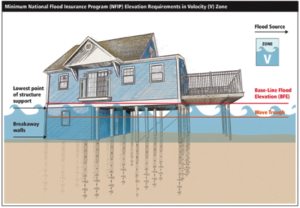
Elevating a home above the flood line can create visual interest in terms of views and multilevel outdoor areas.
The community began rebuilding under the BiB program, tasking IBTS with elevating and rehabilitating more than 180 Breezy Point homes with Community Development Block Grant Disaster Recovery (CDBG-DR) funds. As the responsible party for the management of architectural services for the BiB Elevations Program, IBTS recognized this as an opportunity to take the lead in providing a neighborhood facelift while creating flood- and fire-resilient homes for generations to come.
Start with Strong Communication and Develop Trust
One of the IBTS team’s first steps was to meet with the Co-op and its directors. This gave everyone an opportunity to meet face-to-face and allowed the Co-op to review their guidelines with the team. “They made us aware of their policies, so we were able to get everyone on our end, all the designers and architects, on the same page,” says Jawanza Nyahuma, NYC BiB Architect/Engineering Evaluations Deputy Task Manager for IBTS.
“Having this level of communication at the onset of the process helped make the entire process smoother, preventing misunderstandings and helping build trust between the Co-op and the IBTS team.”
Identify Solutions that Keep the End Goal in Mind
IBTS then worked with the Co-op to establish a plan that adhered to the Minimum Program Standards of the BiB program, while also incorporating the mandates of the Co-op board.
The team recognized a challenge right away when it discovered that the Co-op’s processes for filing and handling paperwork were the opposite of the BiB program’s mandates. “Build it Back was looking to be as paperless as possible, but the Co-op, at least at the inception, wanted paper for everything,” says Nyahuma. “It was a challenge to figure out a process for communicating with the Co-op regarding nearly 200 homes in a way that was still efficient. How do we merge these two approaches?”
The team’s immediate action was to understand how the Co-op wanted correspondence packaged, received and cataloged, and to immediately comply with these guidelines. However, they knew that the pace of mailing hard copies back and forth would slow down the process. “We knew we needed to move so much faster than this was allowing us. So we started looking for how we could tweak the process to make it more efficient without being outside the Co-op’s comfort zone,” says Nyahuma.
One of the first steps the IBTS team took was to hand deliver paperwork initially to avoid delays. “We’d find out who on the team could drive documents over that day,” said Nyahuma. As their relationship with the Co-op grew, the team suggested improvements and the Co-op was willing to accommodate them. Eventually, the Co-op was able to revise their policies and usher in more digitally-friendly approaches.
Focus on Adding Value
Given its role as manager for architectural services for the BiB Elevations Program, IBTS was able to work hand-in-hand with the Breezy Point Co-op to bring many of the shareholder homeowners into compliance with Co-op guidelines. “Homeowners want to do their own thing,” says Nyahuma. “We can make sure that we’re helping them be compliant.”
Ensuring compliance offers an enormous additional benefit to housing cooperatives, who may have struggled with compliance issues prior to the disaster. In the case of Breezy Point, it also restored the consistent architectural character of Breezy Point throughout the community.
Understand the Community
The IBTS team also stresses the importance of knowing the history behind the community as well as the lifestyles of the cooperative’s shareholders. Understanding and incorporating the community’s values can help build trust and increase satisfaction with the process. In Breezy Point, historical and community insights led IBTS to advocate for expanding the types of permitted stairways and landing materials in Breezy Point that helped maintain its historical beachfront feel.
Getting to know both the board and shareholders can also provide useful insight into more nuanced areas, including group dynamics, pre-existing areas of agreement and disagreement, and the community’s willingness or resistance to changes and new technologies.
Through its joint efforts with the shareholders and board of the Breezy Point Co-op, IBTS helped facilitate a recovery process that resulted in the community that was rebuilt with homes in compliance with Co-op and CDBG guidelines, and restored to its historical beauty.
IBTS suggests the following four key areas for working with cooperative housing boards and other planned communities in post-disaster recovery:
- Get to know the cooperative. Communication is vital to building trust, which in turn improves the entire process as well as outcomes. Understand what is important to the cooperative board as well as the community’s history and the its shareholders’ lifestyles.
- Familiarize your team with the cooperative board’s decision-making process and standards. Having the entire team, including architects and designers, understand how to work with the board allows for easier and more productive communications as well as a greater trust between entities, ensuring a smoother process.
- Obtain and understand the most current version of the cooperative’s guidelines. This can save time, and identify potential challenges at the onset of the process.
- Integrate any program procedures and directives within the guidelines of the cooperative’s board. As much as possible, work within the parameters of the cooperative’s guidelines. If any specific guidelines present challenges, discuss how they can be adjusted with the cooperative.